What would work best for you and your family?
Over two million meals later, an innovative home delivery model sparked by this question
The second year of No Kid Hungry’s summer home delivery pilot with Amazon came to a close recently, with over two million meals delivered to kids and families across 18 sponsors in 13 states.
Where this Started
This work began in the summer of 2023, when a historic expansion of the federal summer meals program let schools and community organizations serve rural children through pick-ups and delivery rather than requiring them to eat on site. Rural families that rely on school meals during the academic year face significant challenges during the summer months: 89% of rural families living on low incomes report experiencing food hardship, and children there often live long distances from summer meal sites without reliable transportation. The Program Innovation team at No Kid Hungry wanted to hear from families participating in the new summer meals models. We started interviewing families in Georgia, Arizona, and California to find out what model of summer meal service would best fit into their lives. Families really wanted home delivery but it was rarely offered.
At the time, home delivery seemed too complex for many rural school districts to manage easily. But we knew creating this model mattered to caregivers and kids. So we partnered with Amazon to leverage their logistics infrastructure in new ways to deliver meals to kids in rural locations – for free. We started in 2025 with 5 locations in 2 states. While still a pilot, this model has grown and adapted, and the goal throughout has been how to make this possible for families and reflect their needs and preferences. That question — what works for you — remains the throughline of this work.
How Can Your Experience Be Improved?
One way we keep asking this question is through workshops (sometimes called co-creation sessions) with families participating in the pilot. We use interactive tools to draw out specifics about their experience and what parts of it could be improved. For example, families are asked to consider each stage of their experience – from learning about the pilot through to storing and eating the food that arrives – and rate each step in that journey. The discussion that follows helps us better understand where there is a need for improvement and brainstorm solutions with the families.
In July, we were welcomed in Clinton, Ohio, by the Ottawa County Family Advocacy Center and caregivers who participated in the summer meals pilot. Port Clinton sits just south of Lake Erie, near Sandusky and its famous amusement park, in a county that has faced real economic and community health challenges. The Center’s signature program is called GrandLove– it offers peer support to the growing number of grandparents who find themselves raising their grandchildren. We wanted to hear from them and from caregivers in many different situations to establish where we should prioritize improvements for 2027.
Feedback from these caregivers inform our priorities for the pilot, from what goes in the delivery box, to how to continually innovate the shipping process, and communicate about the program.
Create Your Dream Box
One activity we use is "Create Your Dream Box." Families draw or describe what they would like to see in a box. This activity is inherently aspirational and gives us ideas for nearterm and longterm innovation.
In the activity, participants designed two dream boxes based on the following prompts.
First: “If you were to design a box with one of the following characteristics in mind what would it contain? Choose either health, convenience, or budget-stretching potential.”
Second, “What would you put in a box if you had no constraints at all?”
Caregivers provided specific and practical ideas — protein pastas (maybe even in bulk), low-sugar swaps, fresh fruit, hygiene items — alongside kid favorites like pizza and mac and cheese cups. Hard pass on red pepper hummus and fava beans, for now.
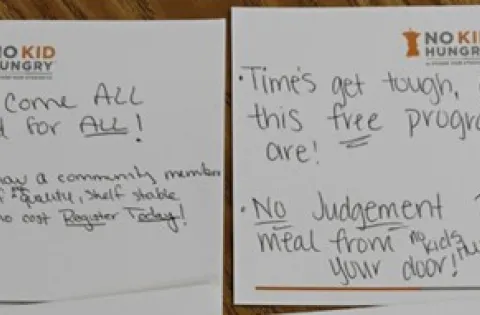
In another activity, we ask participants to create a postcard message to encourage others in their community to participate next year. They decide what information is most important to communicate. In these two examples, caregivers emphasize that all children are eligible in their district and acknowledge the challenges so many families face. 
What’s Next
We're carrying this same approach forward: prototyping, iterating, and expanding based on what families and sponsors tell us. This work is unfinished. Rural home delivery is a complex model being developed within a food system that is even more complex and dynamic. Wading through this complexity with partners across the food system, we try to keep family needs and aspirations as our compass.
If you're a sponsor or partner organization, try a dream box exercise with your families, or host a simple conversation about what's working and what isn't. If you have an idea for something new or different in the meal boxes, get in touch. Later this fall we will share more about the home delivery pilot and the priorities families and sponsors suggest for next summer. Stay tuned!